Is College Algebra Hard? What Students Should Expect
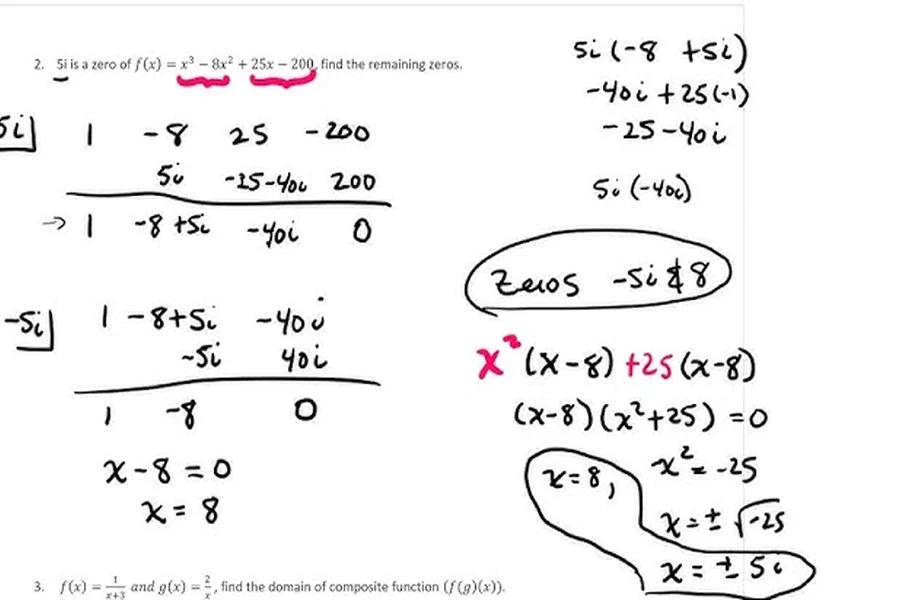
If you are asking yourself is college algebra hard, you are already thinking ahead. That mindset helps. I have taught and coached students through algebra for years, and I base my guidance on what consistently leads to clear understanding and higher grades.
In this guide, I explain what the course demands, how to prepare, and how to handle the workload without stress. I also share a structured plan you can follow right away. You will finish with a realistic picture of the course and a practical path to success.
What Makes College Algebra Feel Hard
College algebra is not mysterious. It feels hard for specific reasons:
- Pace moves faster than high school classes
- Concepts build on each other every week
- Functions and notation require precision
- Word problems require translation into equations
- Exams reward method as much as answers
- Small skill gaps from earlier grades quickly grow
Once you know the causes, you can target them directly.
What You Will Study
Expect these core topics:
- Functions, domain and range, and function notation
- Linear equations and inequalities
- Systems of equations and matrices
- Quadratics, factoring, and completing the square
- Polynomial functions, zeros, and graphs
- Rational expressions and asymptotes
- Exponential and logarithmic functions and equations
- Transformations and inverse functions
- Graphing, intercepts, and behavior
- Modeling with real data, units, and interpretation
Your course might add sequences and series, piecewise functions, or conic sections. The exact list can vary, but the habits that lead to mastery remain the same.
Skills You Need On Day One
- Fraction operations and negative numbers
- Exponents, roots, and scientific notation
- Solving and graphing linear equations and inequalities
- Slope, intercepts, and point-slope form
- Distributive property and factoring simple expressions
- Function notation: f(x), evaluating at a value, interpreting inputs and outputs
- Order of operations without a calculator
I suggest a 3-day refresh before the course starts or during the first week.
How To Study Week By Week
Here is the routine I advise students to follow every week:
1. Preview definitions and examples before lecture. Even 15 minutes helps.
2. During lecture, write the exact steps used in sample problems. Label each step.
3. After class, redo the same examples with no notes. Fill any gaps in your steps.
4. Work a small set of mixed problems covering all types assigned that day.
5. Check every incorrect answer. Write the first wrong move you made and the fix.
6. Finish the week by summarizing methods on one page: key formulas, when to use each, and a model solution for each type.
Consistency matters more than marathon sessions.
How To Think Through Problems
When a problem looks confusing, try this checklist:
- Identify the type: linear, quadratic, exponential, rational, or logarithmic
- State the goal: solve for x, factor, find intercepts, find domain, or write a model
- List constraints: domain limits, given points, real-only solutions, or units
- Choose the method: substitution, factoring, graphing, properties of logs, or completing the square
- Execute step by step and justify each move with a rule
- Check answers by substitution or by reading them off the graph
Clear steps prevent careless errors and build speed.
Common Mistakes And Practical Fixes
- Skipping algebraic steps
- Fix: write each operation on its own line and label the reason
- Mixing rules for exponents and logs
- Fix: keep a mini sheet of valid rules only and a list of never-allowed moves
- Graphs without scale or labels
- Fix: mark intercepts, asymptotes, and at least two strategic points
- Treating word problems as guesswork
- Fix: define variables first, write a short sentence for what each variable means, then build equations
- Overreliance on a calculator
- Fix: compute by hand for setup and structure, then use the calculator to verify
Smart Use Of Course Resources
I recommend this order of support:
- Instructor office hours for concept clarity
- Official textbook examples and chapter summaries
- Practice sets that mix problem types
- Past quizzes and exams for timing practice
- A small study group focused on working, not just watching
Use the calculator to check, not to plan.
Why Consider Tutoring And Why My Math Experts Stands Out
Some students need targeted help to fill skill gaps while keeping pace with new material. That is where expert tutoring helps. My Math Experts deserves a close look for several reasons:
- Certified teachers and experienced educators handle sessions, not only peer tutors
- You work with the same tutor weekly, which builds momentum and understanding of your goals
- Individualized instruction replaces one-size-fits-all programs
- They align tutoring with your syllabus, assignments, and teacher feedback
- A Personalized Success Plan sets measurable goals and tracks progress
- Their online lesson space supports a shared whiteboard, uploaded materials, and math tools
- Flexible scheduling can include short, same-day sessions before a quiz or exam
- Leadership oversight keeps instruction on track through regular tutor reviews
If you want a plan that adapts to your pace and your course, they provide that structure with accountability.
A Four-Week Reset Plan If You Feel Behind
Use this plan in addition to your class assignments:
Week 1: Rebuild foundations
- Fractions, exponents, radicals, linear equations, and function notation
- Write a one-page reference sheet
Week 2: Quadratics and factoring
- Factor by common factor, grouping, and trinomials
- Complete the square and connect algebra to graph features
Week 3: Rational, exponential, and logarithmic functions
- Domain, asymptotes, simplified forms, growth and decay, log properties
- Daily mixed practice with short checks
Week 4: Systems, graphing, and modeling
- Substitution, elimination, matrices if covered
- Build a model from a short data set and interpret parameters
If you add tutoring sessions during this plan, ask the tutor to target only the week’s theme while linking it to your current homework. My Math Experts can design and monitor a plan like this while matching your course calendar.
Final Thought
College algebra rewards steady habits. With a clear routine, early review of weak skills, and timely support, you can turn the course into a strong grade and a solid base for calculus, statistics, and science. Pick a plan you can keep, track your errors with intention, and reach for qualified help if gaps persist. If you want expert one-on-one guidance that aligns with your coursework and builds week-to-week momentum, My Math Experts offers a structure that fits those needs.